Dairy Farmers Can Now Access H-2A: What It Means for You
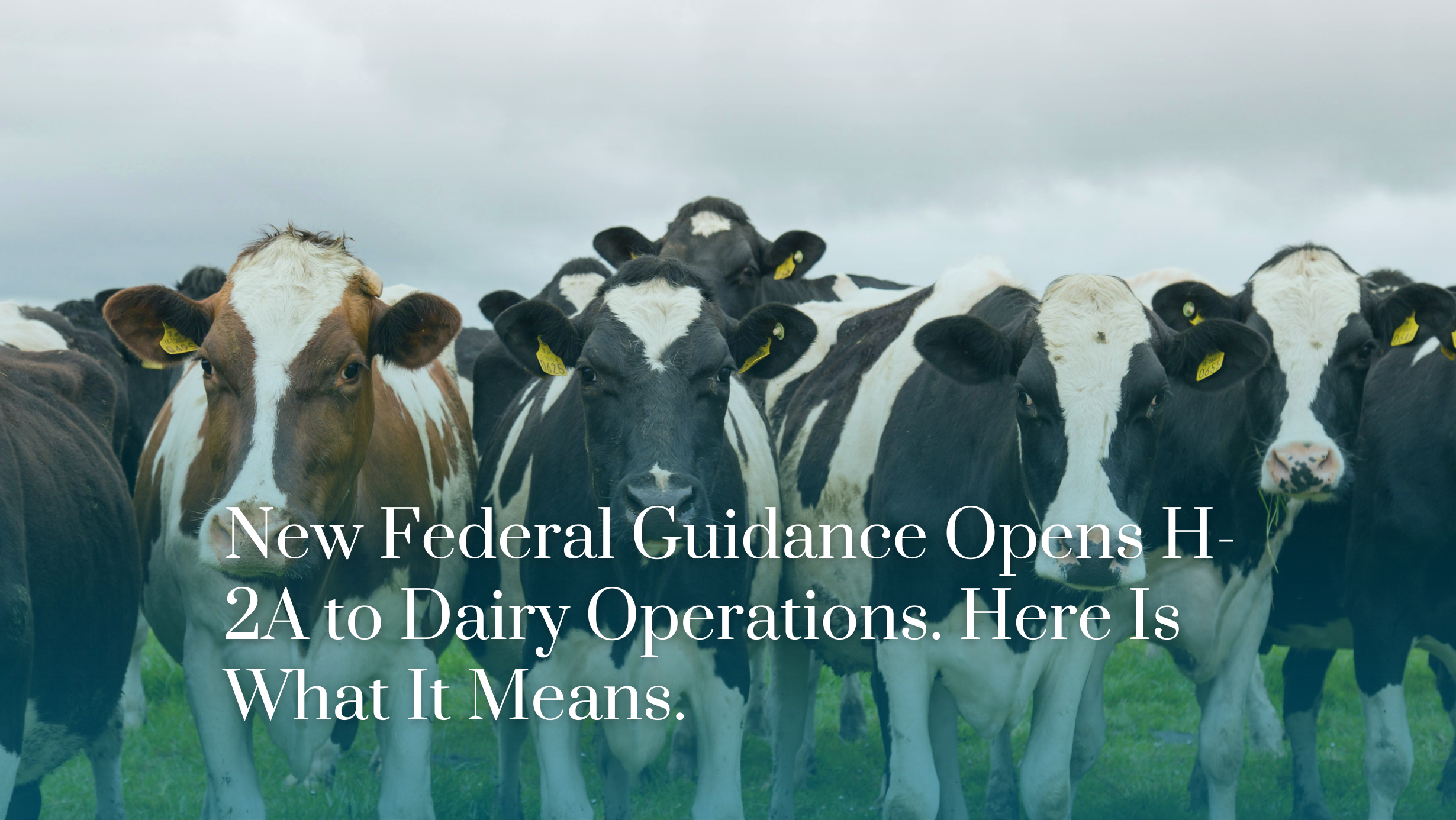
Dairy Farmers Can Now Access the H-2A Program. Here Is What You Need to Know.
For years dairy farmers have watched the H-2A temporary agricultural worker program operate as a lifeline for seasonal crop operations while being largely out of reach for their own businesses. That changed this week.
On June 17, 2026, the U.S. Department of Agriculture welcomed new guidance from the Department of Homeland Security and the Department of Labor clarifying that dairy operations may use the H-2A temporary agricultural worker program when they can demonstrate a qualifying temporary or seasonal labor need under existing law. The policy memorandum provides long-awaited clarity on how USCIS will evaluate H-2A petitions for dairy-related work and marks a significant shift for an industry that has struggled to access legal agricultural labor for decades.
Why This Matters
Dairy is one of the most labor-intensive agricultural sectors in the country and one of the few that operates completely year-round. The H-2A program has historically been structured around temporary and seasonal work, which created a fundamental mismatch for dairy operations that need consistent, reliable labor every single day of the year.
Dairy farmers remain in a particularly difficult position because H-2A has historically covered only seasonal roles, leaving roughly 70 percent of dairy labor needs unmet. That gap has become even more acute in 2026 as agricultural labor shortages have intensified across the country and farms in states like New York and the Pacific Northwest have reported significant disruption to their operations. Economic Policy Institute
The new guidance does not create a separate program for dairy. Dairy operations will be subject to the same statutory and regulatory standards applied to all H-2A employers, with petitions evaluated on a case-by-case basis based on the employer's demonstrated temporary or seasonal need. What it does do is provide explicit clarity that dairying is an agricultural activity eligible for consideration under the program and that dairy operations can qualify when they can document a temporary or seasonal labor need.
What the Industry Is Saying
The reaction from agricultural organizations was swift and positive.
John Hollay, President and CEO of the National Council of Agricultural Employers, called the action a welcomed change and noted that by opening the door for the dairy industry to take advantage of the only legal program for foreign agricultural workers, President Trump is moving the industry in a direction of needed reform.
The National Council of Farmer Cooperatives applauded the announcement, saying the action helps address a key shortcoming of the program and will help ensure access to a legal, stable workforce by dairy farmers across the country. Immigration Policy Tracking Project
That said, the agricultural community is clear-eyed about the challenges ahead. Hollay also noted that for this expansion to succeed and the H-2A program to work as intended, the Department of Labor, Department of Homeland Security, and Department of State will require significant structural support and sufficient funding to ensure the program operates as intended for current and new users.
That is not a small concern. The H-2A program has already seen significant growth in recent years. Approvals under H-2A jumped 25 percent to over 400,000 in fiscal year 2025, and early 2026 data shows continued demand. Adding a massive new sector like dairy to an already strained program will require meaningful investment in processing capacity at DOL, DHS, and the State Department. NCAE and other industry groups are already pushing Congress to provide that support.
What This Means Practically for Dairy Farmers
This is genuinely good news but it comes with real nuance that dairy farmers need to understand before assuming the path forward is simple.
You still have to demonstrate a temporary or seasonal need. The H-2A program was built around seasonal agricultural work. Dairy operations that want to access the program will need to structure their labor needs in a way that meets the program's temporary or seasonal standard. That means the job duties, the duration of employment, and the documentation you provide to DOL all need to reflect a qualifying need. This is not a rubber stamp.
The process is complex. H-2A has always required significant preparation and documentation. Domestic recruitment, prevailing wage determinations, housing obligations, and compliance with program rules apply to dairy employers the same way they apply to every other H-2A user. If you have never been through this process before, working with an experienced consultant is not optional. It is the difference between a smooth filing and a denied petition.
Processing times are a real concern. Even before dairy entered the picture, H-2A processing delays have caused real problems for employers in 2026. In Georgia's Vidalia onion fields, H-2A delays caused 40 percent crop losses in spring 2026 as workers arrived weeks late amid consular pauses. Dairy farmers planning to use the program need to account for the possibility of delays and start the process well ahead of when they need workers on the ground. Economic Policy Institute
Start early. If you are a dairy operation interested in accessing H-2A for the first time, the time to start the conversation is now. The sooner you begin the prevailing wage request and planning process the better positioned you will be.
What Comes Next
The NCAE and other agricultural organizations are calling on Congress to build on this administrative action with legislation that provides a more durable, long-term solution. The current guidance clarifies how existing law applies to dairy operations. It does not change the underlying statutory structure of the H-2A program, which still requires a demonstrated temporary or seasonal need. Congressional action could provide a more permanent pathway for year-round agricultural industries including dairy, mushroom, livestock, and controlled environment agriculture that face the same workforce challenges.
LCI will continue monitoring developments as they unfold and will communicate directly with our H-2A clients as new guidance is issued. If you have questions about how this change affects your operation or whether your dairy business qualifies to access the H-2A program under the new guidance, give us a call!

Related posts
What DOL's September 2 Notice Means for H-2A Employers

Your Fall Filing Window Is Closing. Here's What to Know